Infrasound Detector: Hear What You Can't Hear
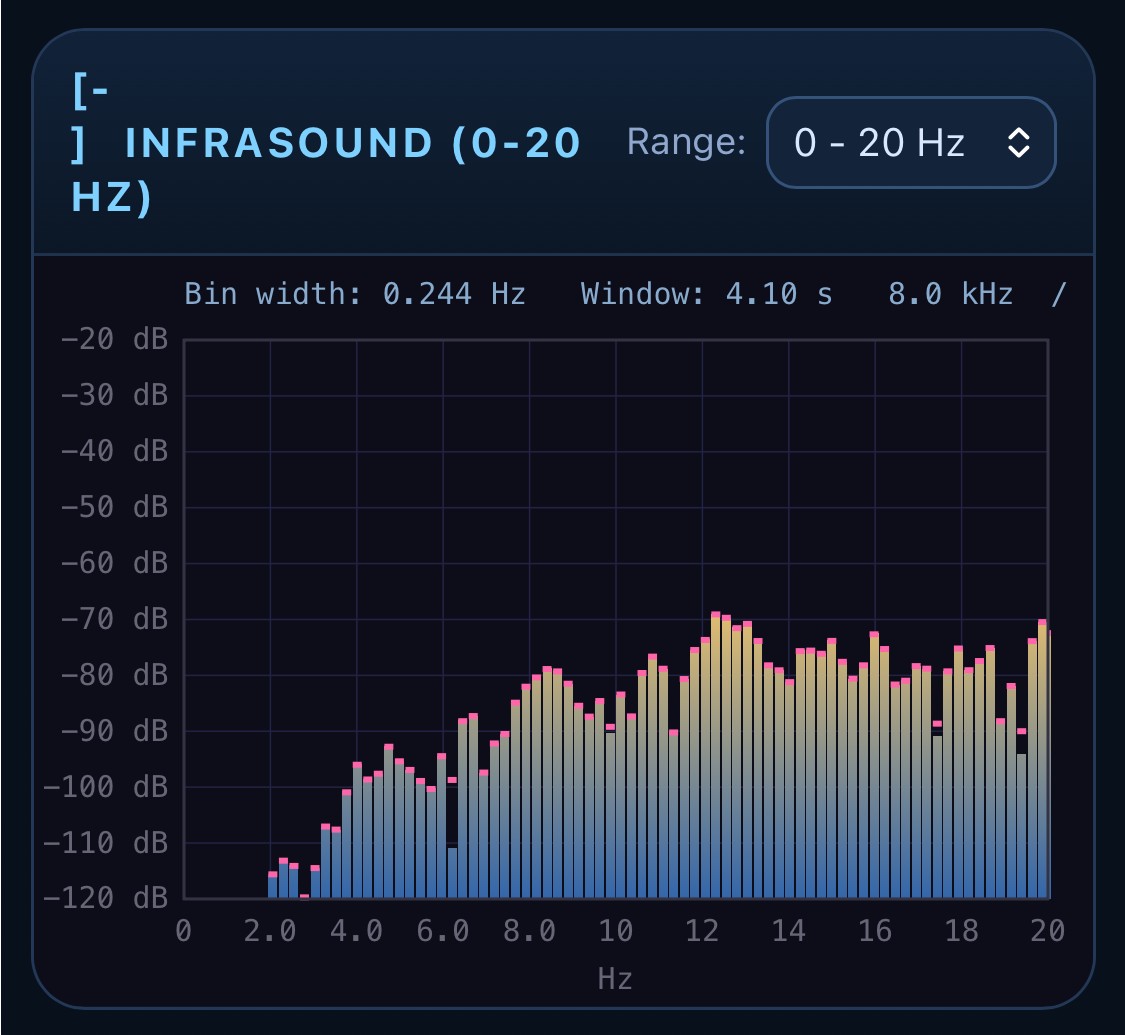
Infrasound is sound below the threshold of human hearing, generally accepted to be anything under 20 Hz. You don't hear it the way you hear a voice or a song, but your body still registers it. It moves through walls, glass, and your skull like they aren't there. And in a lot of modern environments, it's everywhere.
Where it comes from
Common sources include HVAC systems, large industrial fans, wind turbines, refrigerators, subwoofers in a neighbor's apartment, traffic on a nearby highway, certain LED drivers, and even the rumble of a building's structure responding to wind. Storms, ocean surf, and earthquakes produce strong infrasound from miles away. Once you start looking for it, you find it almost everywhere people live and work.
How it affects people
At low levels, infrasound is associated with vague feelings of unease, fatigue, headaches, nausea, anxiety, and the sense that "something is off" in a room without an obvious cause. At higher levels, it can affect concentration, balance, sleep quality, and even trigger sensations of pressure or vibration in the chest. Some of the more famous "haunted room" experiments have been traced back to nothing more than a fan running at a frequency that happened to resonate with people's eyeballs at around 19 Hz. Your body knows something is there. Your conscious mind just can't name it.
How it affects pets
Dogs and cats hear and feel a much wider range of frequencies than we do, and many of them respond to infrasound long before a human notices anything. If your pet is suddenly anxious in one part of the house, refuses to enter a particular room, paces at night, or seems to react to "nothing," low-frequency energy is worth ruling out. Animals routinely flee in advance of storms and earthquakes precisely because they're picking up infrasound that the rest of us aren't.
How it affects equipment
Sensitive equipment notices too. Microphones pick up low-frequency rumble that ruins recordings even when the room sounds quiet. Cameras on long exposures or with stabilized lenses can record a faint blur from infrasonic vibration. Precision instruments, 3D printers, electron microscopes, and turntables all suffer when there's persistent low-frequency energy in the room. If your gear is misbehaving in ways that don't match anything in the spec sheet, the room itself might be the problem.
Find out what's around you
The frustrating part of infrasound is that you usually can't tell it's there. Most consumer sound meters and phone apps cut off well above the infrasound range, so the room reads as "quiet" even when it's saturated with low-frequency energy. I built a browser-based tool that uses your phone or laptop microphone to look specifically at the infrasonic range, so you can actually see what's happening below the limit of your hearing.
Infrasound Mobile Tester
Open it on your phone or laptop and walk through your home, office, or workspace. See in real time whether infrasound is around you.
Open the Infrasound Mobile TesterWhat to do if you find it
If the tester lights up in a particular room, the next step is to figure out the source. Turn off appliances one at a time and watch the readout. Check whether the level changes when an HVAC system cycles. Walk around the perimeter of the room and see if the level peaks near a wall or window. Once you know where it's coming from, you can decide whether to isolate the source, dampen it, or move yourself somewhere quieter. Either way, you'll finally have a name for that feeling that something wasn't quite right.